Showing posts with label economics. Show all posts

Tuesday, November 23, 2010

Economics and economists

For a very long time, I've held a dim view of economics as a "science" and economists in general. It's funny, because I had never taken an economics course. Not in five years as an undergraduate; nor the two extra years I stayed at my alma mater picking up my MA in math. This, in spite of the fact that I had become quite interested in voting theory1.

Not only had I never taken any econ courses, I knew precious few economics majors and almost never talked to them about economics. Off the top of my head, I can remember only one - a fellow who shared a first name, a fencing hobby, and for the first half of his freshman year, an intended physics major with me. He was doing badly in physics and so dropped down into economics because it was easier.

What I did know is what I read about economics and economists. I was familiar that the justification for right-wing economic policies - including a number that seemed to fly in the face of countervailing empirical evidence, such as the old Reaganomic rattle about tax cuts stimulating growth2.

I read biting critiques of economists by philosophers and Richard Feynman. I even read articles by economists trying to demand more respect for their field, but remained totally unimpressed. I did not study economics, and from what I saw, economics was not even a science.

I also thought that economics education seemed to be all about learning how to agree with standard doctrines3. The handful of different approaches to economics, Wikipedia and other sources informed me, were hostile to each other as schools of thought and mainly differentiated by choosing the appropriate sorts of assumptions to back up a particular political faction4.

I knew there was actually some pretty cool stuff in economics - some neat results here and there - but I dismissed economics. I've been frequently heard to declare that economists aren't scientists, but bad mathematicians attempting to do philosophy.

And now?

So instead of trying for a doctorate in physics or pure mathematics (I had funded offers for both), I decided to go California and get a doctorate in a cross-disciplinary institution. I'm still a math man at heart, but my funding comes through the school of social sciences, and in the last year and a half, I've had more interaction with economics, economists, and econ majors than in the rest of my life put together.

I TAed an econ course my first quarter here. I'm taking my first econ course this quarter. At least half the students in my research group come from an econ background.

So here's what I know now. There are economists who are scientists, good ones who believe in the scientific method every bit as much as Feynman did. They seem not to be a majority of the field, but they're actually testing theories of economics. The good ones are studying and applying psychology to understand why people act as they do and then explaining the collective irrationalities we seem to engage in.

Many economists are critical of economics and other economists. Econ graduate students and economists themselves are usually fairly bright. There are a lot of smart economists out there doing a lot of good work trying to figure things out.

While some econ majors are surely the immediate predecessors of the bright, smart, and motivated grad students I meet with on a weekly basis, most of them aren't. If anything, econ majors seem to be wholly different creatures on an entirely different plane of competence. They're terrified of the math that is necessary to get anywhere interesting, and seem to have relatively little understanding of the scientific method.

I'm not sure that my oft-repeated claim about bad mathematicians trying to do philosophy isn't true of the bulk of economists, or economics viewed as an academic field in practical terms. But now that I know some people with economics degrees sitting beside their names who don't fit neatly in that pigeonhole, the fun's gone out of saying it. It just seems like a cheap shot now.

1. It started when I as an undergraduate got to participate in a seminar field-testing this book. It's a field that's been largely populated with economists for the last half-century.
2. That one is a very hard sell for someone who started following the news in the early 90s, watched economic growth follow the Clinton tax hikes, and then watched the economy flatline during the Bush years after being "stimulated" by tax cuts.

3. I actually didn't get that notion from reading articles like that one. I got it from reading between the lines in articles written by economists trying to defend their field, and also from students who'd found economics courses disagreeable.
4. To this day, I believe this is how people who don't make a living in economics decide what school of economic thought is best - take the conclusions that they like and work backwards to justify the assumptions that school swears by. I suppose this may also be true of some economists.

Saturday, July 31, 2010

Chess variations: The life of the party

For those of you who know me personally, you know that I like chess.

You also know I'm not actually that good at chess (granted, I did go undefeated in Martian chess in high school, for the handful of matches that we played) - but I like to have some fun with it. And I also like to spice it up so that all those people who usually don't have much fun with chess will be having a blast.

There are several major variations and hybridizations of chess. One that's good for all ages is Bughouse - partner the best player with the worst player and see how the middle team does. For the athletic crowd, there's chess boxing, which we could use as a template for any martial sport hybridized with chess, but I'm not a big fan of that one.

For the 18+ crowd, there's also strip chess, and for the 21+ crowd, shot glass chess. House rules on how to play these two games vary and are, on the whole, poorly documented, so I'll explain how to do them correctly. And by correctly, I mean this is going to be a fun game that can get played several times in a night without people complaining it's unfair.

Shot Glass Chess

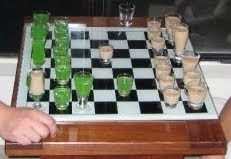
To the right, you can see a shot glass chess game in progress. The author (cream, right-hand side) has just finished capturing a rook (empty 2.5 oz tumbler on the side of the board) from his opponent (green, left-hand side) with his queen (miniature hurricane glass, 4.5 fl. oz). The result of this move is that the author was obliged to drain a 2.5 oz tumbler of Midori sour.

That's the simple rule of shot glass chess: All the pieces are drinks, and when you take a piece, you take the drink. At the end of the match, the loser drinks his or her own king, as the penalty for losing. In the event of a draw, both players face the ignominious result of draining their own kings.

The only tricky part of shot glass chess is setting up the match. There are two types of shot glass chess sets. The type that's easy to find has glasses all of the same size with pictures of the pieces stamped on them. The other type has different sizes and types of glasses for the different pieces, like the one above. Although they're harder to find, you can put one together yourself.

If you want to play great games of shot glass chess, and you don't have a good set, the important thing to know are the piece point values. If you're using the same size glasses, you can either fill the lesser pieces partway up (this works very well with tall, narrow glasses, but not so well with wider glasses), or use drinks of varying strength. Here are the recommended point values.
  • Pawns are 1 point each
    0.5 oz, 4.5% ABV, 1 part liquor to 8 parts mixer, or just a little splash in the bottom of the glass
  • The "minors," knights and bishops, are worth 3 points
    1.5 oz, 13% ABV, 1 part liquor to 2 parts mixer, or fill to one third
  • The "majors," the rooks, are worth 5 points
    2.5 oz, 22% ABV, 1 part liquor to 1 part mixer, or fill to a half
  • The queen is worth 9 points
    4.5 oz, 40% ABV, straight liquor, or filled to full)
  • The king does not have a point value, but should match the queen in size and contents.
If a player manages to graduate a pawn, don't add more liquor - just pour the pawn into the replacement piece. If you're using the listed volumes, the whole chess set is 48 ounces of liquid. 1 oz shot glasses with the mixtures listed above will give about 5 ounces of liquor on each side of the board. Fortunately, the entire board is rarely cleared in a chess game, but it often gets close. Consider using weaker mixtures for smaller opponents, or when playing repeated games.

Strip Chess

Strip chess, unlike shot glass chess, doesn't have a very good set of existing rules. To be fair, it has been marginalized in favor of strip poker, a more psychological and less intellectual game. There are numerous existing variations of strip chess, some of which have actually been played. They generally involve setting up a correspondence between capturing the pieces on the board and removing clothing. One such codification can be found here. Oddly, few of them take the obvious step of simply setting a ratio of points per article of clothing (I would say 5 is about right).

I think, however, this misses how we can add additional depth to the game. In shot glass chess, this depth is provided by automatic handicapping. I propose, instead of assigning point values to clothing, these three rules, which add to ordinary chess the dimension of embarrassment:
  1. If a player loses the match, he or she must remove one article of clothing - chosen by his or her opponent.
  2. At any time, a player may remove an article of clothing - of his or her own choice - in order to return the board to where it was before his or her previous move.
  3. If a player is offered bad advice by one or more bystanders, which results in removal of clothing under rules #1 or #2, the bystanders must each also remove a corresponding article of clothing.
I think it is subtle enough and simple enough to be played as a party game - and amenable to the addition of drinking and the atmosphere of poor decisions at parties. Play chess at a party and you'll be distracted, often wishing you could take back a move.

Rule #3 is optional, but allows for an intermediate level of group participation between team matches (where moves are resolved by committee) and individual matches (where spectators have little to do, but will probably be offering advice - some good, and some bad). One final footnote: You may want to treat "paired" items, such as shoes, as a single item - both in this, and in other strip games.

Strip Shot Glass Chess

It's possible to combine the above games. Why not? Capturing pieces leads to inebriation. Inebriation leads to mistakes. Mistakes lead, in turn, to removing clothing. Chess then becomes your guide to the complete classic party experience. The game you play then has the following additional rules from ordinary chess:
  1. Capturing pieces: If you take a piece, you drink the piece.
  2. Penalty for losing: If a player loses the match, he or she must drain his or her king and then remove one article of clothing - chosen by his or her opponent.
  3. Taking back moves: At any time, a player may remove an article of clothing of his or her choice in order to return the board to where it was before his or her previous move.
  4. Bad advice: If a player is offered bad advice by one or more bystanders, which results in removal of clothing under rules #1 or #2, the bystanders must each also remove a corresponding article of clothing.
There arises a natural question on rule #3: Should taken pieces be refilled with the same alcoholic beverage when the move of their capture is undone? I recommend refilling them with water or juice of the appropriate color to remind players of their mistakes without putting them over their originally intended alcohol consumption. However, if you are using a weak set, you might be able to get away with playing it the other way.

Wednesday, July 22, 2009

The wealth of nations

As of 2008, three of the major GDP estimations agree on the list of the ten richest nations on Earth. First is the US, then, with close to the US GDP between the three of them, Japan, China, and Germany; the lists then all proceed with France, Italy, and the UK (in that order). The final three, which the different lists rank differently, are Brazil, Spain, and Russia.

In a moment of curiosity, I decided to plot these with respect to population... land area... there's not really anything in common with the list. It gets worse when we go a few more places down, which pulls in India and Mexico.

The only thing that's really clear on these lists is that the wealth of nations is still fairly concentrated. The 800 million people in the EU and US control half the world's economy; the 2.5 billion people in China and India control a tenth of it. Mostly that's China speaking, there, India is part of the 2.8 billion population unit that only accounts for 5% of global GDP.

India. The Tiger. The rapidly developing, technologically savvy country. Rapidly growing economy or not, a rising reputation for churning out talented engineers and programmers or not, they're still quite poor in terms of cash dollars.

When I think of all the things I bought, there's very little in terms of durable goods that came from the US or EU; some fencing equipment, some odds and ends, some books - and when I read the 538 post near the end of June (see link above) talking about how to take out about 40% of the world's population for the small price of 5% of the world's GDP, I have to wonder if we aren't undervaluing the contribution these countries make to the global economy when we choose to rely on GDP as a measure of it.

I also have to wonder if it's a question of the value of their labor being truly different, or if it's really more of a product of how money moves. Or doesn't move, as the case may be. Some evidence suggests that the supply and demand for money - and therefore, currency exchange rates - are a large piece of the picture, for when we look at GDP(PPP) figures - measuring local purchasing power - the EU misplaces about three trillion dollars and China picks up a similar amount, rocketing past Japan.

India shoots up from 12th (1.2$T) to 4th (3.2$T). The local goods and services available in India would be worth about three times as much on the European market as Indians actually buy/sell them for. It's amazing, and more than a little bit disturbing, to think that the difference in the value of money is so terribly significant.

Friday, July 10, 2009

The economist's volcano

I went and read another bit of a book written by an economist, and after another chapter of him displaying what I wish were a bad parody of economist behavior, this illustrative scenario occurred to me.

Suppose you have a magic volcano. Not just any volcano; a special magic volcano. When you throw someone into the magic volcano and make a gainful wish, it calls up two immortal beings: An actuary and an economist.

The actuary tells the volcano how many years that person would probably have lived; the economist looks up the current estimated GDP per capita and current market prices of every commodity and manufactured good. Since this is a magic volcano, it can do multiplication, so it takes the GDP per capita and multiplies it by the years of remaining life that person was expected to have.

The next morning, on the slope of the volcano, you'll find whatever you wished for, in whatever quantity, to the market value of that much money - a whole productive lifetime of money right up front, and maybe that particular person wasn't that productive. The volcano doesn't care if they're a hard worker or chronically unemployed.

So, is throwing people into the volcano an act of public good sometimes, most of the time, always, or never? It's certainly a positive economic benefit more often than not, defined in terms of financial value or productivity. Would you want to throw someone in the volcano? What do you expect should - or would - be done regarding this volcano if the news of its abilities spread far and wide?

There's a point to prosperity. I just don't think it's especially important once you've figured out how to keep people alive and well.

Monday, July 6, 2009

Unintended benefits

A little while ago, I was reading an AP opinion piece in the newspaper, titled Disease prevention often costs more than it saves. I was skeptical about its premise, but then I read the article, and the details bothered me more. The example used is that of relying on a personal trainer/lifestyle coach to prevent diabetes.

It's a terribly poor example, and whoever Carla Johnson is, I am sad to report that she appears to be neither a mathematician nor a health expert. True, the annual cost of diabetes is about $4100 initially (ref - note, however, that it rises over time) and we are, hypothetically, spending $5400 or $6300 a year to prevent it (note: The article says "$5400" but also says that for every person that this sort of treatment works for, it fails six others, and seven times $900 is $6300, not $5400). So on diabetes, we're saving $600-700 or so per person per year with this program, hypothetically, if each year of the program leads eventually to 1/7 of one year free from diabetes for one person.

However, the health benefits of having someone sort out your diet and exercise problems are not limited to not getting diabetes! Diabetes is the big-ticket item, sure. But is it the only thing? Obesity is linked to many other health problems. What the article author should instead be comparing is the cost of the program - which we expect would be discontinued after the first year or so if it were not making a difference - to the average increased cost of being overweight and not exercising, not just diabetes.

And then there's the other side of the question of cost effectiveness: We have not only a significant portion of the costs being repaid in saved diabetes bills, and much (quite possibly all) of the remainder being repaid in other medical bills; we have additional years of healthy productive life, fewer sick days, etc. Direct medical costs are only about half the total price tag of obesity (ref) and so, even hypothetically paying $900 a year indefinitely for personal lifestyle coaching is, on the scale of a national system, a good idea. After all, we're looking at an expected average positive payout at that point.

So the example is quite poorly considered. Is there a valid point to the op-ed piece? Well, yes. An ounce of prevention is not always worth a pound of cure, and it's worth actually checking to see if it is. But a valuable moral of the story is that you have better be very thorough in weighing the costs of everything being prevented. Narrow focus on particular kinds of costs while ignoring others is how we wound up with this system in the first place.

Thursday, June 25, 2009

Markets want to be conservative?

The other day I said something that should strike a reader as odd: Markets want to be conservative. And in that, I did not mean "conservative" as a collection of political positions that some pundit might want to assign to the term; I mean the much older and more literal meaning of the term. The sort of market economy we have today resists some types of change.

It's not an inherent property of the market itself. It's a product of social influence. With the creation of each market, each service, each industry, a special-interest group is created. The invention of the personal automobile lead to the automotive industry - and all those involved in the manufacture, sale, and maintenance of the automobile have a vested interest in consumers using cars, and will try to influence policy to fit.

The only change that the market embraces is one that makes someone more money; privatizing prisons, for example, has backfired by creating a lobby - one with, in many cases, pre-existing ties to state legislators that landed them the contracts in the first place - with a vested interest in increasing the prison population. Insurance companies have a vested interest in preventing health care reform - because successful reforms would obliterate their bottom line.

In a land where everything is for sale - including legislative access and the publicity needed to get into office - the market provides incentives for parties to fight against change. We've seen it with the tobacco industry; we've seen it with state-run lotteries; we're seeing it now, once again, with health care. In each case, the profit motive of the private sector puts the brakes on changes in public policy.

When I look at the privatization of prisons, I am not surprised that some states may achieve short-term savings in higher efficiency operations; I am also not surprised that in the long term, it comes back to bite them in the tail, as suddenly there's a group that benefits if recidivism rises, if indeed crime rates rise, and fundamentally if prison populations rise - a motive that does not exist in a publicly run prison.

Thursday, June 18, 2009

The case for throwing money at higher education

I've been thinking long and hard about my home state's funding priorities as it moves into a budget crunch. The annual earnings of an individual tend to increase by about $5,000 for every additonal year of higher education; North Carolina spends somewhere in the range of $5,000 to $15,000 in educational subsidies for that year of higher education, depending on where the student goes.

And I ask myself: What sort of investment will take a series of $15,000 up-front payments and pay out $5,000 a year for each payment you make into it - for several decades? Sure, the state of NC takes a longer time to recoup tax revenues, but that is an enormous public benefit for the amount of money being spent. Where can we get more of this?

When I look at North Carolina on the long term scale, the biggest difference I see between North Carolina and its neighbors is the UNC system. North Carolina supports a large number of public universities and community colleges, and subsidizes the tuition of in-state students very heavily. There's a very bright future in continuing to throw money at higher education at every level - as much as the state can afford to do.

Sunday, May 31, 2009

Gripes about the housing process so far...

The most talked-about part of the offer my graduate school sent me was the graduate housing guarantee. Having read it, and gone on to read the most recent internal committee report on the housing guarantee, and then read the rates quoted on the website, I thought that this meant that I would have some variety of affordable housing. Barely affordable, but affordable.

What I didn't read was the noise-filled, flash-intensive website of a private subcontractor, who runs the other graduate housing units, the ones that the university doesn't actually own. The rent is much higher in these privately-run "luxury apartments."

Seriously? You're going to use the word "luxury" in describing graduate student housing? Someone's priorities are messed up. If I had gone on to read those rates, and realized that my school was going to put me in one of the expensive apartments, and that they would be asking for two rent payements prior to even moving in... well, the  offer would have looked a lot less attractive.

The margin for housing to be considered "affordable" is 30-35% of income. By that standard, in order for the cheapest rent in the housing run by the private subcontractor to be considered even marginally affordable by Federal terms (35% of income spent on rent), you need an income of $26,000. Which is more than they pay graduate students. And to afford a single? Over $40K. This is enormously different from the units the university actually runs themselves.

And may I go back to the front-loading, and the silly fees? Application fee of $20. Security deposit of $150. $12.95 extra for them to process a credit card payment through a fourth party (how many middlemen are taking a cut?) and the first two months' rent due August 1st and September 1st when the move-in date is September 19th. Graduate student orientation? Guess. It's the 17th, and if you want to move in early, you get charged extra.

If I had known all of this earlier, I might have decided that thal school's financial support was simply unworkable. As is, now, I will find a way to manage to make ends meet, but you can bet I'm not happy about it. The fees are the most ridiculous part. I'm paying an 8.6% fee to reduce your paperwork? Even Paypal does not charge so much - and taking it out on the payee?

Perhaps in California, students are accustomed to going neck-deep in debt to afford housing, and it's considered essential to have a "resort-style" swimming pool at your apartment complex, etc. But where I come from, graduate students aren't interested in paying an extra $300-$500 per month to live in more luxurious digs. They're interested in having enough left over for groceries and just maybe putting something aside to work on those student loans they accumulated as an undergrad.

I know, I know, this is how the subcontractors make a mint and get their boat payments. But you'd think if the university was aware that problems affording housing both drive away prospective graduate students and prevent existing graduate students from making it through the program in a timely fashion (or at all, in some cases), they'd try to make sure the housing they were offering was affordable. And they are aware. I read the survey results cited in that report.