Tuesday, November 23, 2010

Economics and economists

For a very long time, I've held a dim view of economics as a "science" and economists in general. It's funny, because I had never taken an economics course. Not in five years as an undergraduate; nor the two extra years I stayed at my alma mater picking up my MA in math. This, in spite of the fact that I had become quite interested in voting theory1.

Not only had I never taken any econ courses, I knew precious few economics majors and almost never talked to them about economics. Off the top of my head, I can remember only one - a fellow who shared a first name, a fencing hobby, and for the first half of his freshman year, an intended physics major with me. He was doing badly in physics and so dropped down into economics because it was easier.

What I did know is what I read about economics and economists. I was familiar that the justification for right-wing economic policies - including a number that seemed to fly in the face of countervailing empirical evidence, such as the old Reaganomic rattle about tax cuts stimulating growth2.

I read biting critiques of economists by philosophers and Richard Feynman. I even read articles by economists trying to demand more respect for their field, but remained totally unimpressed. I did not study economics, and from what I saw, economics was not even a science.

I also thought that economics education seemed to be all about learning how to agree with standard doctrines3. The handful of different approaches to economics, Wikipedia and other sources informed me, were hostile to each other as schools of thought and mainly differentiated by choosing the appropriate sorts of assumptions to back up a particular political faction4.

I knew there was actually some pretty cool stuff in economics - some neat results here and there - but I dismissed economics. I've been frequently heard to declare that economists aren't scientists, but bad mathematicians attempting to do philosophy.

And now?

So instead of trying for a doctorate in physics or pure mathematics (I had funded offers for both), I decided to go California and get a doctorate in a cross-disciplinary institution. I'm still a math man at heart, but my funding comes through the school of social sciences, and in the last year and a half, I've had more interaction with economics, economists, and econ majors than in the rest of my life put together.

I TAed an econ course my first quarter here. I'm taking my first econ course this quarter. At least half the students in my research group come from an econ background.

So here's what I know now. There are economists who are scientists, good ones who believe in the scientific method every bit as much as Feynman did. They seem not to be a majority of the field, but they're actually testing theories of economics. The good ones are studying and applying psychology to understand why people act as they do and then explaining the collective irrationalities we seem to engage in.

Many economists are critical of economics and other economists. Econ graduate students and economists themselves are usually fairly bright. There are a lot of smart economists out there doing a lot of good work trying to figure things out.

While some econ majors are surely the immediate predecessors of the bright, smart, and motivated grad students I meet with on a weekly basis, most of them aren't. If anything, econ majors seem to be wholly different creatures on an entirely different plane of competence. They're terrified of the math that is necessary to get anywhere interesting, and seem to have relatively little understanding of the scientific method.

I'm not sure that my oft-repeated claim about bad mathematicians trying to do philosophy isn't true of the bulk of economists, or economics viewed as an academic field in practical terms. But now that I know some people with economics degrees sitting beside their names who don't fit neatly in that pigeonhole, the fun's gone out of saying it. It just seems like a cheap shot now.

1. It started when I as an undergraduate got to participate in a seminar field-testing this book. It's a field that's been largely populated with economists for the last half-century.
2. That one is a very hard sell for someone who started following the news in the early 90s, watched economic growth follow the Clinton tax hikes, and then watched the economy flatline during the Bush years after being "stimulated" by tax cuts.

3. I actually didn't get that notion from reading articles like that one. I got it from reading between the lines in articles written by economists trying to defend their field, and also from students who'd found economics courses disagreeable.
4. To this day, I believe this is how people who don't make a living in economics decide what school of economic thought is best - take the conclusions that they like and work backwards to justify the assumptions that school swears by. I suppose this may also be true of some economists.

Saturday, July 31, 2010

Chess variations: The life of the party

For those of you who know me personally, you know that I like chess.

You also know I'm not actually that good at chess (granted, I did go undefeated in Martian chess in high school, for the handful of matches that we played) - but I like to have some fun with it. And I also like to spice it up so that all those people who usually don't have much fun with chess will be having a blast.

There are several major variations and hybridizations of chess. One that's good for all ages is Bughouse - partner the best player with the worst player and see how the middle team does. For the athletic crowd, there's chess boxing, which we could use as a template for any martial sport hybridized with chess, but I'm not a big fan of that one.

For the 18+ crowd, there's also strip chess, and for the 21+ crowd, shot glass chess. House rules on how to play these two games vary and are, on the whole, poorly documented, so I'll explain how to do them correctly. And by correctly, I mean this is going to be a fun game that can get played several times in a night without people complaining it's unfair.

Shot Glass Chess

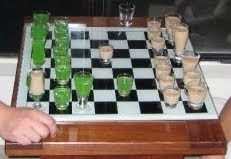
To the right, you can see a shot glass chess game in progress. The author (cream, right-hand side) has just finished capturing a rook (empty 2.5 oz tumbler on the side of the board) from his opponent (green, left-hand side) with his queen (miniature hurricane glass, 4.5 fl. oz). The result of this move is that the author was obliged to drain a 2.5 oz tumbler of Midori sour.

That's the simple rule of shot glass chess: All the pieces are drinks, and when you take a piece, you take the drink. At the end of the match, the loser drinks his or her own king, as the penalty for losing. In the event of a draw, both players face the ignominious result of draining their own kings.

The only tricky part of shot glass chess is setting up the match. There are two types of shot glass chess sets. The type that's easy to find has glasses all of the same size with pictures of the pieces stamped on them. The other type has different sizes and types of glasses for the different pieces, like the one above. Although they're harder to find, you can put one together yourself.

If you want to play great games of shot glass chess, and you don't have a good set, the important thing to know are the piece point values. If you're using the same size glasses, you can either fill the lesser pieces partway up (this works very well with tall, narrow glasses, but not so well with wider glasses), or use drinks of varying strength. Here are the recommended point values.
  • Pawns are 1 point each
    0.5 oz, 4.5% ABV, 1 part liquor to 8 parts mixer, or just a little splash in the bottom of the glass
  • The "minors," knights and bishops, are worth 3 points
    1.5 oz, 13% ABV, 1 part liquor to 2 parts mixer, or fill to one third
  • The "majors," the rooks, are worth 5 points
    2.5 oz, 22% ABV, 1 part liquor to 1 part mixer, or fill to a half
  • The queen is worth 9 points
    4.5 oz, 40% ABV, straight liquor, or filled to full)
  • The king does not have a point value, but should match the queen in size and contents.
If a player manages to graduate a pawn, don't add more liquor - just pour the pawn into the replacement piece. If you're using the listed volumes, the whole chess set is 48 ounces of liquid. 1 oz shot glasses with the mixtures listed above will give about 5 ounces of liquor on each side of the board. Fortunately, the entire board is rarely cleared in a chess game, but it often gets close. Consider using weaker mixtures for smaller opponents, or when playing repeated games.

Strip Chess

Strip chess, unlike shot glass chess, doesn't have a very good set of existing rules. To be fair, it has been marginalized in favor of strip poker, a more psychological and less intellectual game. There are numerous existing variations of strip chess, some of which have actually been played. They generally involve setting up a correspondence between capturing the pieces on the board and removing clothing. One such codification can be found here. Oddly, few of them take the obvious step of simply setting a ratio of points per article of clothing (I would say 5 is about right).

I think, however, this misses how we can add additional depth to the game. In shot glass chess, this depth is provided by automatic handicapping. I propose, instead of assigning point values to clothing, these three rules, which add to ordinary chess the dimension of embarrassment:
  1. If a player loses the match, he or she must remove one article of clothing - chosen by his or her opponent.
  2. At any time, a player may remove an article of clothing - of his or her own choice - in order to return the board to where it was before his or her previous move.
  3. If a player is offered bad advice by one or more bystanders, which results in removal of clothing under rules #1 or #2, the bystanders must each also remove a corresponding article of clothing.
I think it is subtle enough and simple enough to be played as a party game - and amenable to the addition of drinking and the atmosphere of poor decisions at parties. Play chess at a party and you'll be distracted, often wishing you could take back a move.

Rule #3 is optional, but allows for an intermediate level of group participation between team matches (where moves are resolved by committee) and individual matches (where spectators have little to do, but will probably be offering advice - some good, and some bad). One final footnote: You may want to treat "paired" items, such as shoes, as a single item - both in this, and in other strip games.

Strip Shot Glass Chess

It's possible to combine the above games. Why not? Capturing pieces leads to inebriation. Inebriation leads to mistakes. Mistakes lead, in turn, to removing clothing. Chess then becomes your guide to the complete classic party experience. The game you play then has the following additional rules from ordinary chess:
  1. Capturing pieces: If you take a piece, you drink the piece.
  2. Penalty for losing: If a player loses the match, he or she must drain his or her king and then remove one article of clothing - chosen by his or her opponent.
  3. Taking back moves: At any time, a player may remove an article of clothing of his or her choice in order to return the board to where it was before his or her previous move.
  4. Bad advice: If a player is offered bad advice by one or more bystanders, which results in removal of clothing under rules #1 or #2, the bystanders must each also remove a corresponding article of clothing.
There arises a natural question on rule #3: Should taken pieces be refilled with the same alcoholic beverage when the move of their capture is undone? I recommend refilling them with water or juice of the appropriate color to remind players of their mistakes without putting them over their originally intended alcohol consumption. However, if you are using a weak set, you might be able to get away with playing it the other way.

Thursday, December 31, 2009

2009: A good year for movies

I've seen several movies this year in first-run theaters. I know, unusual, right? I've even been positively impressed. I saw Star Trek, Up!, District 9, The Hurt Locker, and Avatar.

And I'm definitely thinking that District 9 and Avatar are good science fiction movies, of the sort we haven't seen too many of lately. They were good, they were serious, and they were original. It's not really a combination we see too often, but the similarity doesn't stop there. Both films were exploring alienation, race, and loyalty, edgy topics that simply were not fashionable when Bush was president.

Both have a human plunged into the society of the aliens, experience the oppression humans place upon them first hand, turn against the human military apparatus, and become physically transformed into aliens themselves. Both films make exceptional use of aesthetics - the Prawn are revoltingly ugly, and the gritty documentary style makes the ugliness of the slum life very real. The Na'vi, on the other hand, are strikingly beautiful, and the film is visually gorgeous.

Both make intense use of historical metaphor to talk about the times in which some humans - and yes, ladies and gentlemen, white Western European industrial English-speaking humans, if we're to be specific - have decided to treat other humans as subhuman. District 9 uses apartheid. Avatar uses the american indian wars. I even noticed Colonel Quaritch, the military leader in Avatar, making what seemed like a deliberate reference to the Ghost Dance.

Now that Obama is in office, those who found it fashionable to be not only patriotic, but nationalistic and jingoistic are becoming rabidly anti-American, cheering when Chicago lost its bid for the Olympics, jeering when a sitting president is handed a Nobel prize. The Democrats haven't picked up the slack; nationalistic fervor has tapered. If The Hurt Locker had the temerity to suggest that some soldiers get hooked on the rush of putting it all on the line in Iraq back in 2004, would it have been labelled anti-American and bad for soldiers' morale?

And heaven forbid that a film show ex-US Marines as ruthless mercenaries engaging in massacring civilians. But that nationalistic fervor has faded, enough that it's no longer fashionable. Suddenly, it's fashionable to talk about race, to examine the question of social identity.

I suppose the bombing of the Home Tree plays a little more like My Lai than any of the battles of the Indian Wars we're familiar with, complete with the soldier who says they didn't sign up for this and decides they've had enough, but I don't think the Vietnam War is a much more comfortable piece of history than the systematic destruction of the american indian nations.

I've heard a few people complain that Avatar has no plot. I count several - a conflict between science and short-term ignorant greed, a romance, a unification story, a sequence of alienation, initiation, and adoption. It's not even badly written, and I didn't spot so many of the egregious hard-to-ignore physics errors so common in flashy big-budget SFX movies. Spiderman 2, I'm looking right at you. That was painful. Anyway, back on topic:

Good science fiction tries to push a little bit beyond our comfort zone. When I see some people reacting in a very visceral way to the "race traitors" of District 9 and Avatar, I see it as a sign those movies are doing something right. Aside from making half their critics look like white supremacist nutjobs, they're prodding hard enough to make some very meaningful statements and ask people questions they might not ask themselves enough.

The moral I see in both films is this. It doesn't matter if they're ten foot tall blue beauties in a neolithic tribal structure or technologically advanced tentacled bugs who get high on cat food, everybody deserves to be treated with a full measure of "human" dignity. If we don't, we are already traitors to our ideals. And that's a radical statement, because we have a devil of a time managing that with other humans.

Thursday, November 26, 2009

The length of an elven lifespan

One thing that gets me in fantasy literature: Elves, and how long elves live. Usually, we see elves living incredibly long lifespans "off-screen." Since they don't age, we see elves living thousands and thousands of years. Naturally, in the course of events that happen on-stage, they die off in fairly large numbers due to unnatural causes.

Elves aren't invincible. Some kinds of elves, such as Tolkien's elves, are immune to disease. These elves only die due to violence, lethal accidents, or suicide. Our first order estimate is therefore based on the most recent statistics for that - the WHO 2002 report on mortality. We see that 83 out of every 100,000 people die traumatically violent untimely deaths, and an additional 8 out of 100,000 starve to death.

With humans, this varies with age, but since elves are unaging and unchanging beings, we'll assume the average rate holds for all elves of any age. Thus, each year, 0.091% of all elves die. This means that the elven time of death is drawn from a simple exponential distribution with parameter λ = 0.00091.

The mean of an exponential distribution is simply 1/λ, so the average elven lifespan is 1100 years. The median elven lifespan is shorter - 760 years - and about 40% of elves live past their first millenium.

But 2002 was not that violent of a year. War, genocide, and famines tend to happen in short sharp "spikes." Only 2.8 people per 100,000 died as a result of war in 2002; over the course of the 20th century, about 10 billion people drew breath. 6 billion of those lived to see the end of it, and somewhere in the neighborhood of 200 million died in excessive spikes of "mass death" - famines and wars. That's 2,000 per 100,000 per 100 years; taking the appropriate 1/100th root, we get an average of 40 per 100,000.

If we take out today's war deaths and famine deaths and substitute an averaged value of 40 for "mass death" events, we get about 120 per 100,000. At λ = 0.0012, the average elven lifespan is 830 years, and the typical elf lives a mere 580 years. Only 30% of elves live to see out the end of their first millenium. One out of every 160,000 would live to see their tenth millenium.

Not all fantasy mythos leave elves immune to disease - and infectious disease represented 175 per 100,000 deaths in 2002. Historically, diseases have killed far more than violence and starvation, even among the healthy "young adult" population (smallpox, tuberculosis, measles, scarlet fever, malaria, outbreaks of various plagues - these can kill at any age) - so if elves aren't immune to disease, we would probably want to see λ to become substantially larger and the elven lifespan much shorter.

In the limiting case, where we consider lethal accidents, violence, and disease terms more typical to the dark ages? Well, let's just say that two or three centuries doesn't seem like such a short time for an elf to live, after all.

Thursday, November 12, 2009

Context and quality

The other night, I was talking with a lovely poli sci student and wound up bringing up Jumper, which would appear to be three related things:
  1. A 1992 book I greatly enjoyed reading several times 10-15 years ago and classed as an exemplar of the writing craft (though not necessarily the writing art).
  2. A 2008 movie widely reputed to be bad.
  3. A 2007 book written to tie into the screenplay.
I have yet to experience items number 2 and 3, but I wonder: Would, today, I still enjoy item number 1? Would I enjoy it if I encountered it for the first time now? The terrorist-obsessed vigilante might seem much more heavily worn after living through 8 years of terrorism-obsessed politics; the damaged young man struggling to connect with a normal life and normal relationships might not be nearly as sympathetic a character.

And perhaps my standards for the writing craft have changed. I was impressed not with the plots or characterizations of Jumper, but by what I saw as a remarkably smooth flow of words, a mechanically well-put-together piece of fiction. I read 1-2 other books by the same author not long after, and was unimpressed with them. But today, would I apply the same standard? Do I care more or less about the craftsmanship that went into a book - and do I consider the same things good?

I suppose I should re-read it and see what I think of the book now, but re-reading a book is never the same as encountering it for the very first time.

Thursday, September 3, 2009

The socialized medicine we already have

The public dialog surrounding health care has become fairly frustrating to me. There's a generation gap, an information gap, a comprehension gap, and not only that, but plenty of hypocrisy and misinformation going around.

First: No, the US health care system is not the best in the world. We may have the best experts on some diseases, and very good health care, but the overall quality of care, system-wide, is no better than tenth in the world. Even Forbes magazine - hardly a bastion of socialism - puts the US at 11th healthiest. In 2000, the WHO put the US health care system as 15th best - 37th accounting for how much we spend.

No matter what anecdotes Fox News, the Wall Street Journal op-ed pages, or anybody else spout about the horrors of socialized medicine, the fact of the matter is that nearly every serious look at the data tell us that Canada, the UK, Sweden, etc have far better health care systems.

Second: The US already has government-provided health care. For 2005, the WHO calculates total government spending on health care in the US at $2,862 per capita (out of a total of $6,350 - yes, both figures have risen substantially in the last 4 years). In other words, between Medicare, Medicaid, the Veteran's Administration, and other government provided insurance and health care systems, Uncle Sam pays directly for about 45% of all health care.

I don't believe that counts the employer tax break, which as an indirect subsidy amounts to about $500 per person, and Medicare spending has grown sharply in the last four years. Government insurance programs cover directly more than a quarter of the population directly, and the subsidies affect half the population.

The result of selectively covering the poor, elderly, and disabled is one of the most expensive (and least efficient) government health care systems in the developed world. The US government, in 2005, spent more money per capita on health care than the Canadian government, the German government, the UK government, the Swedish government, and most of the other European governments you hear about when people start talking about socialized medicine and universal health care.

Iceland, Switzerland, and Denmark's governments all spent more than Uncle Sam in 2005 - in nominal terms, but in terms of purchasing power parity (everything is more expensive there), they spent less than our government. Austria pretty much matches us in PPP terms; so far as I can tell, the French and Norwegian governments alone spent more money on health care than our government did.

In fact, US government spending on health care is about the same as total health care expenditures - public and private - in the countries I usually use as examples, Japan and Sweden. (Anyone think that Japan has a recent history as a bastion of socialism?)

So if "government provided health care" is a form of socialism ... ladies and gentlemen, I present to you the United States: The world's third or fourth most socialized medicine on the planet - and the only one in the top 20 that can't manage to cover all its citizens.

Third: The generation gap. What a lot of people don't seem to understand is that employer health benefits are on the downslide. And that matters a lot more for us young folk, who are part-timers, new hires whose contracts don't have grandfathered care, entrepreneurs, subcontractors, self-employed, and generally get the short end of the stick when it comes to government subsidies and government-provided coverage.

I'm 25. Mortality and disease and high health care bills are pretty uncommon in our age bracket - but there aren't many of us who don't realize that skimping on preventative care now will cost use when we're older, or that one accident, one unusual disease will completely wipe out our pocketbooks and put us in the hole. Not only that, but we probably won't even be able to get care until later in the course of a disease or long-term condition if we aren't covered, and that means it'll get a lot worse.

And so most of us are strongly in favor of health care reform. It's not surprising; we're right there. We can see our self-interest, and we can see our taxes fueling a system that spends enormously and inefficiently on everybody else. And when I hear about all the older folks hollering and protesting at "town hall" meetings about "socialized medicine," I can't help but think: There is someone who probably benefitted from government-subsidized health care for several decades of their life, and is probably covered directly by Medicare now.

And I think to myself that they are probably more than a little bit of a hypocrite. They have socialized medicine. They're probably afraid it'll get cut if the government stretches out to pay for everybody - something I think about a lot when I look at how older folk respond to intimations of Medicare cuts. Those young people, they don't need insurance, most of them are really healthy - so many of the older generation seems to think.

And who is going to be paying for this, paying for the growing national debt, paying for any health care reform? Most of today's retirees aren't going to be paying many taxes twenty or thirty years down the road. Most of today's young people will. So when I see members of the older generation fighting health care reform tooth and nail, I look at the demographics and the statistics and I think to myself that it looks like most of the protesters are engaging in an exercise in hypocrisy.

But back to the issure of young people needing coverage. Here we come to the comprehension gap. Because when it comes to having health care, it's do or die. And so when it comes to insurance, you need coverage that will handle a major emergency, which in a market where the government is paying for most of everybody else's ticket, in a market where you can't shop around between more than a handful of providers, in a market where bloated middlemen work hard to make their share larger, in a market with an enormous information gap, means that you're completely fucked if you're a little fish on your own shopping for coverage.

I happen to have gotten lucky in that my graduate school actually provides health coverage as part of my funding package, and it might even be adequate coverage in the event of a major medical emergency. I don't know yet. There's always a lot of fine print, and I haven't spent several weeks reviewing it - not that I could afford to buy adequate coverage on my graduate stipend. I don't exactly have a choice there.


So. That turned out to be a longer rant than I expected, and there's so much more I could talk about, but I'll leave you with the summary and the recap. First, other countries do actually have better health care systems. Second, the US government is already spending enough to provide universal coverage and better coverage. Third, your experience and understanding of this country's health care is going to vary radically based on age and socioeconomic background.

At the risk of sounding like a teenager, many of you making loud objections really just don't understand. The holes in the system are a lot more visible to those of us living in them, and to those who trip over and fall in one.

Tuesday, August 4, 2009

A secession scenario, part III

The past two installments of this series have been discussing a hypothetical Republican-led anti-Obama secession movement and what things would look like if about one third of the states seceded. Today, I'd like to spend just one moment turning the map inside-out.

When I constructed the ASA, I started off by taking every state that has a Republican legislature, a Republican governor, and voted against Obama. I.e., we didn't include Florida, because Florida voted for Obama. I then added the two states Obama did worst in (Wyoming and Oklahoma) despite their Democratic governors, and threw in Montana because they have been surrounded. Now let's do the opposite, for fairness' sake - what's the Democrat-ruled Obama Nation look like?

OK, so let's take the states that voted for Obama and have wholly Democratic state governments - so not including Arkansas and West Virginia, Democrat-run states which voted against Obama. Now add Hawaii and Vermont because Obama did best in those two states (in spite of their Republican governors). Connecticut and Rhode Island we now add for geographic reasons.

Unlike the ASA, we can't connect all the Democratic states of America using only four states - but there is one state that Obama polled over 60% in that we haven't included, and it's a big enough state to make an entire "disputed region" all by itself: California. So here's our map, for completeness.

The highlighted states (blue) have a population of 98 million and a GDP of $4.9 trillion ($50,200 per capita). You can see how much less geographically contiguous this group is - scattered across the country in five different pieces. And I think that highlights the point perfectly.

Now, if the ASA's GDP per capita was barely below the US average, and these Democratic states average well above the US average, that tells us something really odd that I don't think I've heard before. The most bipartisan states in the union, as a group, number in their group most of the poorest states. Maybe it's a historical anomaly that the states whose local governments and presidential preferences are split are poorer than those who are entirely red or blue in 2008; maybe it actually means something.